All Stories articles
Marcus Kenneth Glass was from the North East and built in the North East. Working as an architect in the early twentieth century, he translated his designs through a distinctly personal lens, one shaped by his own understanding of Jewish identity. That his name remains largely unrecognised today is arguably a consequence not of the quality of his work, but of his geographical marginality in the North East and a career cut devastatingly short by an early death.
Biography
Marcus Glass, born Yekusiel Glaz, arrived in Newcastle from the Russian Empire in the 1890s as a small child. Born third out of six children, his parents Max (Mendel) and Dana were originally from Riga, Latvia. Glass studied at Armstrong College in Newcastle and set up his architectural practice in 1914, but the outbreak of the First World War put a stop to his private practise as he was quickly taken up in the war effort under the Royal Engineers. After the war he was able to return to his architectural work and set up office on Saville Row in Newcastle. He married Hannah Woolf at Hammersmith Synagogue in 1922 and they moved to a villa in Jesmond, an affluent middle-class suburb of Newcastle, where he renovated the home himself. He became a RIBA fellow in 1925.

Plan by M.K. Glass of the proposed synagogue on Ravensworth Terrace, Newcastle upon Tyne, 1924. Tyne and Wear Archives and Museums reference - T186/A2326/3
Jesmond Synagogue
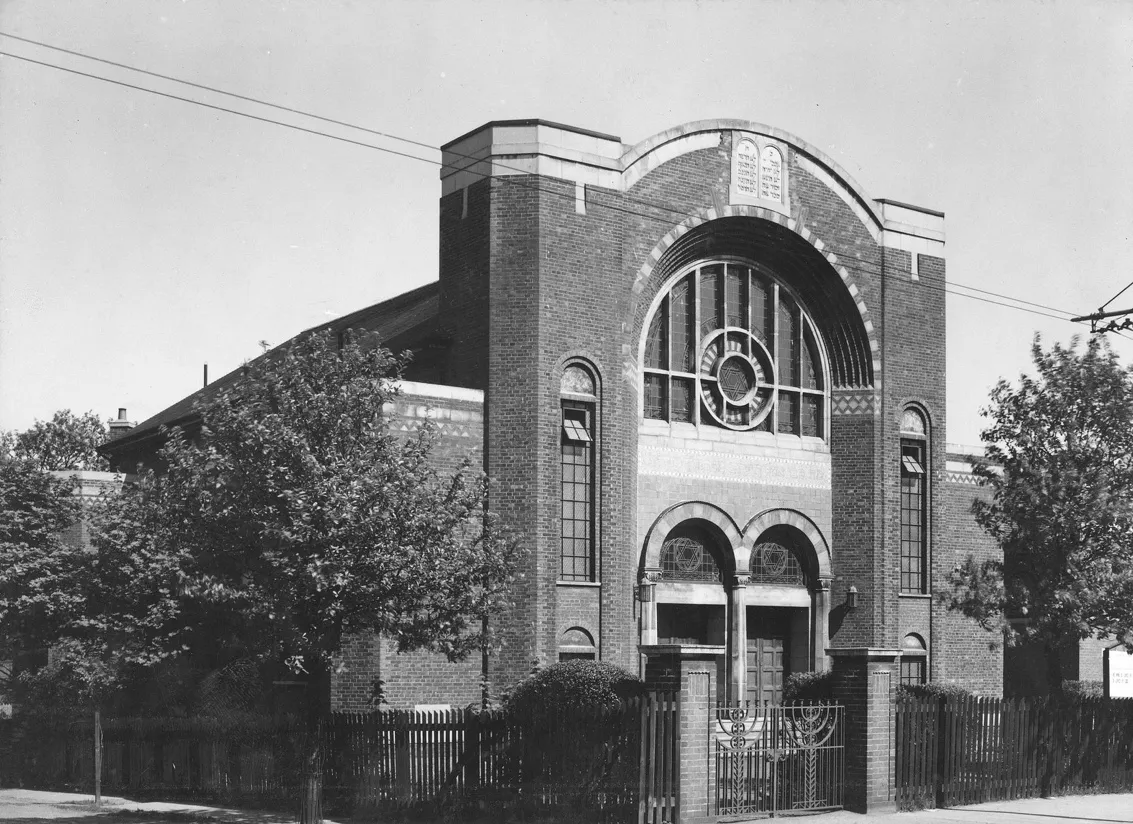
Jesmond Synagogue can be understood as Marcus Glass’ foundational work. A precursor to his synagogues in Sunderland and Clapton, elements of Glass’ signature decorative approach were first realised here, on Eskdale Terrace. The redbrick façade is punctuated by a triple-arched entrance portico. The two-toned decorative brick work and horizontal stripes give it a graphic quality, a nod to both the Byzantine influences and art deco architecture popular at the time. In the large stained-glass window, a sunburst Star of David reflect golden yellows, shades of blue, and punctuations of red and green into the interior space. The Hebrew inscription frieze in a turquoise mosaic is the building's most striking feature. It reads, ‘Mah tovu ohalecha Ya'akov mishk'notecha Yisrael [transliteration of Hebrew script]: ‘How fair are your tents, O Jacob, your dwellings, O Israel’ (Numbers 24:5), a traditional blessing often used to open daily services.

Photograph of exterior of Jesmond Synagogue, 39 Eskdale Terrace, 2026. Image taken by author.
Following early Jewish settlement in the West End, Newcastle’s Jewish population was beginning to move out towards the suburbs. By the early twentieth century around 100 Jewish families were living in Jesmond. Sometimes referred to as the Jesmondites, these families decided to erect a new synagogue as their distance from the main Leazes Park Synagogue made it difficult for elderly members to attend services and for children to attend cheder (religious classes). Originally the synagogue had hoped to remain affiliated to Leazes Park, which became known as the Old Hebrew Congregation, however, discussions and negotiations failed, leading to the establishment of an independent congregation in 1914.
Smaller in size than his later projects, this community-focused building is intentional in its design, reflecting both the sacredness of the space in Jewish religious, social and cultural life, but intimate in its scale - a place of significance without being monumental - fitting for the creation of a new neighbourhood synagogue.
Sunderland Synagogue
Ryhope Road Synagogue was Glass’ most ambitious work. It was commissioned for Sunderland’s Hebrew Congregation after their previous building, on Moor Street, was no longer seen to be fit for use. When the Moor Street synagogue was first built in the middle of the nineteenth century, the East End was the epicentre of Sunderland’s Jewish religious, professional, and family life. But by the twentieth century the Jewish community was beginning to move out of the city centre, further away from the docks. The Building Fund was subsequently established in 1911, the jubilee year for the Moor Street Synagogue, but it took a further 11 years for the Building Fund Committee to be given the green light to purchase the land on Ryhope Road and hire Marcus Glass to design a purpose-built structure.

Photograph of Ryhope Road Synagogue, Sunderland, unknown date. Image courtesy of Sunderland Museum & Winter Gardens, reference number TWCMS : J7705
Opened over a decade after Jesmond, the scale of Ryhope Road is a dramatic divergence, yet the design elements follow on from his earlier work. Red brick throughout is contrasted with cream and red brickwork alternating above arches. A similar Hebrew inscription in a turquoise mosaic is found across the full width of the central elevation. The semi-circular stained-glass window with a Star of David roundel is punctuated by a stone tablet with the Ten Commandments. Built in the midst of the interwar period, Glass embraced art deco sensibilities even further with a band of zigzag brickwork encircling the building.
Orientalism and ‘Jewish’ Architecture
The neo-Byzantine style that Glass developed in his synagogues was informed by his own views on Jewish identity. His friend C.B.Moses recalled:
‘On our visits together to a number of London Synagogues, Mr Glass often expressed to me his disappointment at the absence in some of them of what he terms the ‘Oriental’ atmosphere. He maintained that no matter in what country Jews lived, they were an Eastern race, and in the building of his Synagogues he would always give prominence to that Oriental feature’.
This orientalism that Glass was aspiring to evoke was nonetheless expressed through a decisively contemporary lens, with Sharman Kadish, Anglo-Jewish architectural historian, identifying the ‘cinematic style’ through which Glass interpreted the ‘oriental’, not too far beyond the popular Art Deco style of his time.
Oriental is a word understood today as imbued with negative connotations and power dynamics. However, in the early twentieth century, many Jews and non-Jews alike were using such terms in negotiating and defining a Jewish people as a distinct group, nation, and at times, race. Indeed, in 1925, whilst Glass was working on Ryhope Road Synagogue, Lewis Mumford published his article ‘Towards a Modern Synagogue Architecture’, asking questions including: ‘...which were the traditional sources of Jewish culture? How far could they be used in these times? ...whether the synagogue should be in harmony with the buildings surrounding it, or ... stand out, proclaiming the cultural individuality’.
Not all architects of British synagogues were Jewish, indeed Glass may have been one of the few of his time, so this insight into the ethos behind his architectural practice reveals the ways he infused his professional work with his own understandings and negotiations of what it meant to be Jewish in Britain. His architectural work reflect a hybridised Anglo-Jewish identity against the backdrop of a rapidly shifting world where antisemitism was intensifying across Europe, Jewish nationalism was growing, and first and second generation immigrants, like Marcus Glass, were living out their lives negotiating multiple interwoven identities.
Why Marcus Glass is Important
His colourful facades are striking, bold, and graphic. They become all the more significant when viewed today, in a time when synagogues aim to blend in discreetly. Glass’s synagogues resist the urge to blend in unnoticed – they are confident assertions of Jewish life in the North East. So confident, that perhaps those who funded them, built them, and prayed in them, could not imagine them standing empty today.
His Synagogues in Sunderland and Jesmond still stand, despite his Clapton Synagogue in London having been demolished in the early 2000s. They no longer serve as places of worship with Sunderland having been empty for decades now and Jesmond having become a residential block of flats.

Photograph of exterior of Ryhope Road Synagogue, 2024. Image taken by author.
Sharman Kadish wrote about the ever-evolving patterns of Anglo-Jewish migration that led to the kind of synagogue life cycles we see in the North East, whereby ‘communities viable enough to build a synagogue in one generation have been obliged to close it in the next’. With the rise and decline of populations, it is the buildings themselves that become the proof ‘that Jews once lived there’ – even as buildings do not constitute a community in themselves, and Jewish life in the region pre-dates them and will continue to exist beyond them. Similarly, the legacy of Marcus is tied to the structural safety of these buildings. His early death at just 45 cut his career short, never having had the opportunity to build his portfolio and be given the opportunity to be celebrated the way he deserved. Yet for those who know where to look, Jesmond and Sunderland synagogues continue to stand for now as a powerful reminder of his work, his perspective as a first-generation Jewish immigrant architect, and the creativity and beauty to be found in the North East’s Jewish heritage.
Researched and written by Sophie Bellamy, PhD candidate at Durham University. Her research explores the rise and decline of North East Jewish communities in collaboration with Tyne & Wear Archives
References
Anat Falbel, ‘Lewis Mumford and the Quest for a Jewish Architecture’ in Nationalism and Architecture 1st eds. Darren Dean, Sarah Butler, and Raymond Quek (London: Routledge, 2012).
Sharman Kadish, Jewish Hertiage in Britain and Ireland: An Architectural Guide, Historic England (2015).
Sharman Kadish, The Synagogues of Britain and Ireland: An Architectural and Social History, Yale University Press (2011).
Arnold Levy, History of the Sunderland Jewish Community, 1755-1955, London: Macdonald (1956).
Lewis Olsover, The Jewish Communities of the North East of England, 1755-1980, Ashley Mark Publishing Co. (1980).
