All Stories articles
Ethan Shanks, a History undergraduate student from Newcastle University, researched the records relating to the Maier family and their businesses. Here he tells the story of their escape from Nazi Germany, their becoming 'refugee industrialists' on Tyneside with the establishment of their company Distinctive Clothing.
As the power of the Nazis grew in Germany, many German-Jewish families sought refuge outside of the country. While many settled in the U.S., some chose to come to Britain, settling all around the country. These Jewish families came with knowledge and skills in many areas, in particular, a group of Jewish migrants that were referred to as ‘refugee industrialists.’ This group brought much needed business enterprises to deprived areas of the UK, including the North East, bringing vital light industries and jobs to replace the declining traditional heavy industries. The Maier family were a part of this group specialising in clothes manufacturing, especially in boyswear, initially setting up on the Team Valley Industrial Estate.
The Team Valley Estate, the first and largest government-financed industrial estates created through the Special Areas Act of 1934. These estates were aimed at fostering development and jobs to deprived regions. These areas proved to be great opportunities for refugee industrialists to restart their lives in a new country, using their already acquired experience and expertise in their fields to set up successful businesses on these estates. For the Maier and other refugee industrialists, these estates also provided them a stepping stone to expand and move their businesses to other parts of the North East. Many refugee industrialists were known as such and from 1937 to the start of the war, the state and departments of the Special Areas organisation worked to find and assist the transfer of refugee industrialists from mainland Europe to the now constructed Special Areas across Britain.
But, equally important, is the North East provided these refugees, who left Nazi Germany with very little, the opportunity to restart their lives and a place that they would come to regard as their home. They became more integrated and part of their local communities over time. The stories of the Maier family show a narrative of resilience, determination, and close family and community bonds that uplifted both the family and region.
Life in Germany
The two youngest of four brothers, Albert and Martin Maier were born in Rogowo, Germany (now in modern-day Poland) to Jewish parents Isidor and Fredericke in 1890 and 1893. They grew up there until, Martin was enrolled into the Imperial German army in World War One. After the war, Martin married Helwig Mendershausen or Mendershausen-Neumann who was born on February 10th 1898 in Preußen, Germany to Jewish parents, Oskar Mendershausen and Rosa Neumann. Both brothers moved to Berlin, after the war, where Albert set up a clothing manufacturing company called Albert Maier & Co., which Martin also joined. Martin and Helwig would have two sons together with Werner Oskar (Later changed to Werner Oscar) being born in 1930 and his younger brother in 1932.
Under Nazi rule, the Maiers put up with many forms of discrimination such as signs prohibiting Jews from using certain shops or public spaces and a young Werner and his brother being denied from watching the 1936 Berlin Olympics by a police officer who bribed the two away with some chocolate. The increasingly unfavourable situation in Germany prompted Albert to move to Newcastle, in 1938 and set up a new tailoring and clothing manufacturing business on the Team Valley Trading Estate, Gateshead called Tevaclo Ltd. [Team Valley Clothing Company]. For the rest of the Maier family, the situation became more perilous during Kristallnacht with the school and synagogue they used being burned down. This came to a point of crisis when in 1938, Nazis attempted to arrest Martin who fled on a bike. Martin then undertook a herculean endeavour where he cycled from Berlin, avoiding arrest, and crossed the German-Dutch boarder, there he was sheltered by a farmer before he cycled his way to Holland and got passage to Newcastle by boat, linking up with Albert. Meanwhile in Germany, after Martin’s escape from Nazi authorities in Berlin, the Gestapo seized the family home and forced Helwig to pay ‘rent’ for the Maier’s own house. The family was also frequently visited by Nazi enforcers who demanded to know where her husband was, all the while Helwig had one of Martin’s brothers hiding in their basement.
Once secure in Britain, Martin sent for his family in Berlin who were granted refuge under Britain’s immigration policy with child refugees at the time, where they were granted visas by the Home Office on the condition that their care could be provided by private individuals or voluntary organisations. Despite this, it likely did not prevent the roadblocks the family had to clear when trying to leave Nazi Germany. Nevertheless, the family was reunited in 1939, a few weeks before Britian’s declaration of war on Germany. The pressures put on the family, especially on Martin and Helwig shows their resilience, strength and determination in enduring and overcoming Nazi oppression. Helwig’s resilience and strength to keep the family afloat even as the Nazis put ever increasing pressure on her and her family, while having to take care of two children herself. And, Martin’s determination and strength to resist and evade the Nazis and travel great distances without family support to secure them a life away from Nazi persecution.
Tragically, the oldest of Albert and Martin’s brothers; Julius and Max Maier, who were also industrialists specializing in men’s clothing manufacturing and Helwig’s mother, Rosa, all died at Auschwitz. Julius on July 11th 1942, Rosa on the 5th February 1943, and Max on May 2nd 1944.
Settling into life in Britain
Martin joined up with Albert to co-manage Albert’s company on the Team Valley. However, with Britan’s declaration of war against Nazi Germany, Albert and Martin were interned as ‘enemy aliens’ on October 9th 1939 in line with the Alien Restriction Act. This happened to many Germans and Austrians living in the UK to prevent people potentially loyal to the Nazi regime causing internal problems. Internees remained interned until a tribunal verdict based on evidence were made, placing them into either Category A, B or C, with C clearing them of suspicion and released without restrictions. Both were released in late 1940, being classed as category C and allowed to continue business on Team Valley, but the business had suffered during the twelve months the brothers were interned, with only around 41 workers in 1941. During the war, the company changed its line of production to military uniforms to aid the war effort, but after the war it switched back to civilian clothing manufacturing, particularly, boyswear.
In 1942, Martin broke off from his brother’s company to form his own, Distinctive Clothing Ltd., which also operated on the Team Valley, producing boys' formalwear, but both companies maintained close contact. The company started off with forty second-hand sewing machines and ninety employees, supplying thirty individual schools with boys schoolwear from ages 5-15, including the Royal Grammar school. In 1947, Martin attained British citizenship, thereby, granting his sons citizenship as well. Sometime after World War Two both brothers moved their companies into Tower House, Tower Road, Newcastle - near where Manors Station is today.

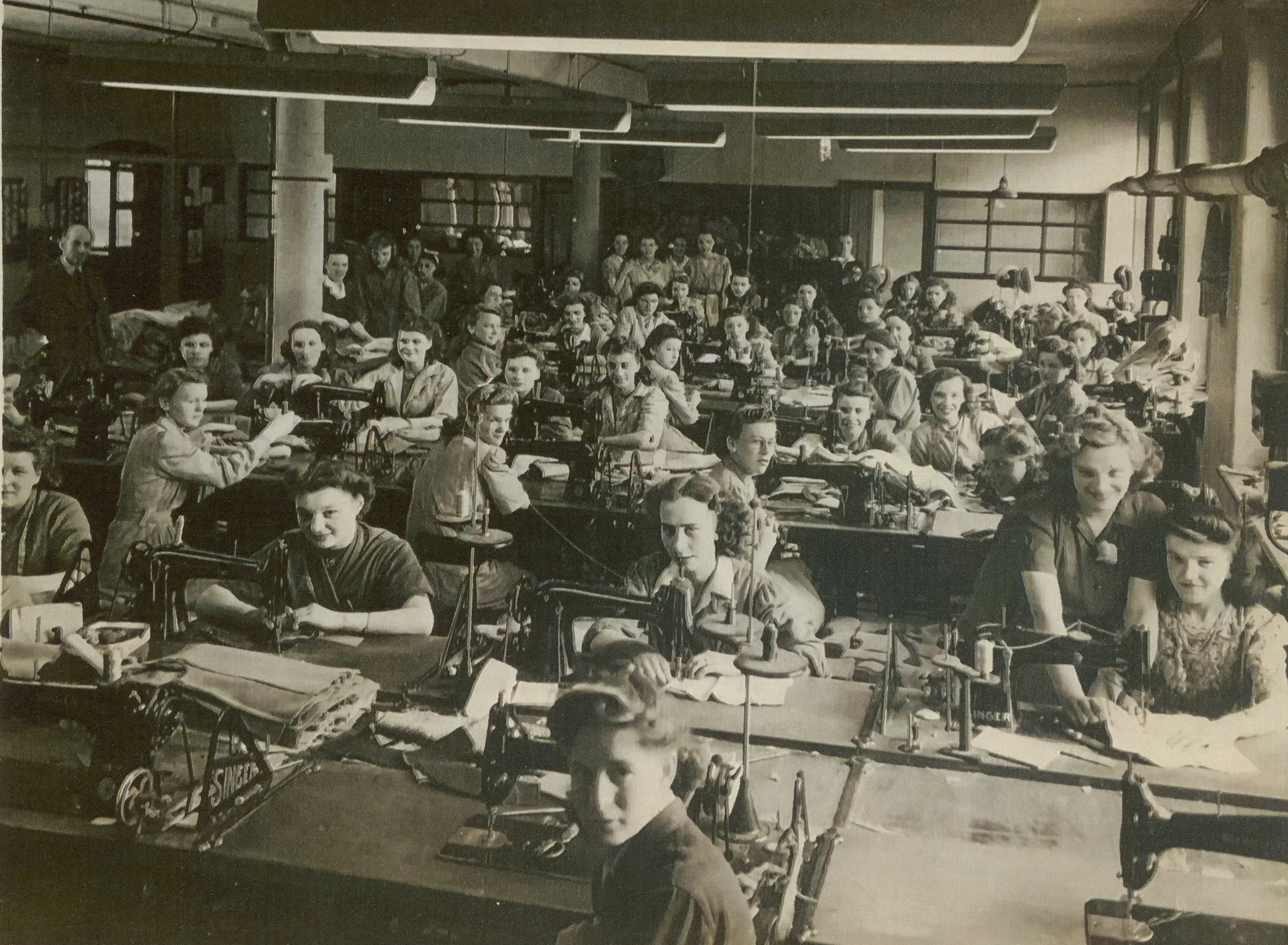
Inside the Distinctive Clothing factory on the Team Valley, Gateshead. DF.MAI/4/14
In Newcastle, Werner was also settling into his new life being educated at West Jesmond School and then the Royal Grammar School. He also at this time, met his close friend Freddie Ichenhauser (Later changed to Ingram), who was also Jewish and left Germany with his brother, on Kindertransport in 1937. In the early 40s, Freddie invited Werner to his first Newcastle United football game, where he fell in love with the club. By the 1946/47 season, Werner was an enthusiastic supporter of and regular at Newcastle home games going to all but one that season. Unfortunately, the game he missed due to it falling on the Jewish Holy Day of Yom Kippur, requiring him to attend the service at Leazes Park Synagogue, was Newcastle’s largest ever victory being 13-0 over Newport County. Near the end of the 40s Werner gets a season ticket in the West Stand where he and Freddie watched Newcastle together for over 60 years.
Postwar Movements and Changes
Around 1955, Werner moves to London to take a course at the Tailor & Cutter Academy and then enters his father’ business, becoming an industrialist specialised in manufacturing clothes, like many others in his family. In 1958, Werner married Freddies’ cousin, Edna Zeitlin, they would have a happy marriage of 65 years and had three sons together and eventually became grandparents.
At Tower House, both companies experienced growth and by 1963, the Tevaclo Ltd. was employing 100 workers. Around the early 1960s, Albert retired and sold the company to the Northern Division of Steinberg & Sons Ltd., and three years later it was resold to unknown interests, who operated outside the North East. Around this time, the company moved away from Tower House to somewhere outside the North East. In the late 1960s, due to his declining health, Martin handed the business over to his son, Werner. One businessman, who knew Martin recalled that the company under him was always “a pleasure to visit and they were always made to feel very comfortable” and that the place had a sense of warmness and friendly atmosphere. Martin died in 1970 aged 77 and Albert died the next year in London in 1971, aged 80. Helwig died in 1972, aged 74 and was buried under the name Hedwig Maier in a joint grave with her husband.
Werner Oscar Maier and the Continued Rise of Distinctive Clothing Ltd.
Under Werner’s ownership, the company continued to grow and thrive. In 1974, the company employed 120 people and in 1978 the factory moved from Tower House to Industry Road, Newcastle. Distinctive gained a reputation as a family business, this was supported by Werner’s kind and friendly personality, which provided the company a workforce that respected and were loyal to him, with many generations of the same families working for the company. The company had become a regular appearance at annual exhibits and trade fairs in London, Paris, America and Dubai showcasing their products. In 1985, with the company’s decades of expertise in manufacturing boys’ school and formalwear, it started to diversify its products into producing casualwear at high-quality.
By the 1990s, the company was especially known for quality schoolwear under the Marmair brand and supplied to major national department stores such as Selfridges, John Lewis and House of Fraser. The company’s clothing quality was also internationally recognised becoming an exporter to Ireland, continental Europe, the Middle East and United States, selling 100,000 waistcoats a year across Europe and Middle East with exports making up a third of company income. By the early 1990s, the company was making an annual turnover of £3 million. In the 1990s it employed 115 people and able to produce 100 different styles of blazers, overcoats and raincoats for schoolwear, supplying over 600 schools by 1993, including top private schools like Dulwich Collage, London.

Outside the Distinctive Clothing Ltd. factory on Industry Road, Newcastle. DF.MAI/4/14
After more than two decades as the owner, Werner sought to take a step back and sold the business. He resisted buyouts by rival companies, desiring to keep the company independent and preserve the family atmosphere. Werner then accepted company’s purchase by David Goldwater and Alan Coulter in 1992, who had an existing connection to the company as assistant managing director and company secretary. He remained in a consultation role at the company after the buyout for at least three years working on special projects. Business partners and employees who worked with Werner held him in high regard, considering him “the most experienced, knowledgeable, and nicest businessman in the Boyswear trade.” Employers under Werner gained a sense of pride to have worked for Distinctive and for working “for an employer who is fair, considerate and always careful of the welfare of the people who work for him,” something they saw as a privilege.
After Werner retired, he remained an active and respected member of the Newcastle Jewish community. He was chairman of a local Jewish Israel Appeal (JIA) group going to regular services at originally Leases Park, and later at Jesmond and Gosforth synagogues and remained an avid supporter of Newcastle United Football Club.
Conclusion
The story of the Maiers and their impact on the North East shows how important they and other refugee industrialists were to the revival of the North East economy, the war effort, and bringing numerous jobs to locals. But equally, the North East’s impact on the Maier family shows how key the region was in providing them and other refugee industrialists a chance to rebuild their lives and businesses, and even more importantly, a home that would grow into a deep connection to the region, its people and culture.
The family run nature of many refugee industrialist businesses, like Distinctive Clothing, while run initially as a means of restarting their lives had a key human side to their business model. Their longevity in their roles and familiarity with locals over the years gave the company an impression of warmness and closeness with its local community, employees and customers, while also providing long-term stability. This closeness further meant closer alignment between boss and employee on worker welfare and care that also speaks to the moral character of these refugee industrialists.
